
Connected Production: The Foundation for Smart Production
Connecting machines, making production data available, and linking systems together—connected production is the technical foundation of all smart production. What is often a routine task today opens up enormous potential in practice. Using concrete examples from over 25 years of industrial automation, we’ll show why connecting production systems is worthwhile.
Without connected production, there can be no smart production
Anyone who wants to optimize production, automate processes, or make data-driven decisions needs one thing first and foremost: access to data from their machines, equipment, and systems.
That is exactly what connected production is all about. Machine controls, sensors, energy meters, and other production components are digitally connected so that information can be exchanged and made available for further applications.
Yet connected production is not a new invention. More than 25 years ago, it was already possible to retrieve data from machines via OPC servers and make that data available to other systems.
What has changed since then are, above all, the technical capabilities. Standardized interfaces, Ethernet connections, and high-performance communication solutions have greatly simplified machine connectivity.
As a result, connected production today is less of a technological vision and more of a fundamental task that every manufacturing company should tackle.
During the Lunch Talk, Sören Rose and Mike Elsen will discuss connected production. They’ll share personal experiences, specific customer examples, and insights into why technical connectivity is the first step toward smart production.
Watch the video now:

From the First OPC Server to Networked Production
The immense potential of machine connectivity was already evident around the year 2000.
At one customer's site, a Siemens S7-400 was connected via a traditional OPC server. It took just a few configuration steps to read the current system status directly from the controller and display it on a screen in the office.
For the customer, this was a "lightbulb moment": information that had previously been available only directly at the machine could suddenly be used elsewhere.
Today, such connectivity is largely taken for granted. The basic idea, however, has remained the same: Make data available where it is needed.
However, production is by no means limited to Siemens control systems. In many companies, control systems and devices from different manufacturers operate side by side.
Solutions such as the Kepware Server, with more than 150 communication drivers, make it possible to access these heterogeneous systems via standardized interfaces. OPC UA has emerged as an important standard for industrial data exchange.
Connected Production in Practice: Four Examples
The benefits of connected manufacturing become particularly clear when you look at specific applications.
1. Track fuel levels automatically instead of writing them down by hand
At a manufacturing plant, an employee would take daily tank level readings at midnight and record them on paper.
The process was time-consuming and prone to errors. Transposed digits, missing decimal places, or delayed data transfers could disrupt the subsequent billing process.
By digitally linking the fuel data, this process could be automated.
From then on, inventory levels were available at the right time—without the need for manual reading and transcription.
The benefits: Less effort, fewer transmission errors, and a more reliable data foundation for billing.
2. Integrate label printers into production
Label printers are also an important part of the production process. They ensure that products and intermediate goods can be clearly identified.
However, print data is often still entered manually on the device. Many industrial printers, such as those from Zebra or Videojet, have network interfaces and can be supplied directly with the necessary information. Printer languages such as ZPL can be used to automatically transfer label data and, in some cases, layouts as well.
This transforms what was previously an isolated piece of equipment into an integral part of the production process.
The potential: Fewer manual entries and the ability to link printing processes directly to production orders.
3. Connect compressors and detect peak loads
Compressed air is a significant source of energy consumption in many manufacturing facilities.
At one customer's site, analysis of the compressor connections revealed that several units frequently started up simultaneously. This resulted in high electrical load peaks that could lead to significant costs. It was only through the available operating and consumption data that this behavior became systematically apparent.
Based on this, the company was able to organize the use of its electrical appliances more intelligently and reduce energy costs.
The conclusion: Without the connection to the compressors, it would have been much more difficult to understand the relationships.
4. 500-kW Motor: Making Energy Waste Visible
Another example comes from a farm with a large milk dryer.
There, a 500-kW motor was routinely turned on half an hour before production actually began. The reason given was that the motor needed to warm up first. This unusually early start was noticed through the collection and visualization of energy data. A follow-up inquiry with the equipment manufacturer revealed that the warm-up was not necessary at all.
This helped prevent unnecessary energy consumption.
This example clearly illustrates how even the simple availability of production data can lead to concrete improvements.
Machine integration is often a standard task these days
The good news is that many companies already have the technical infrastructure for connected production in place today.
Machine controllers have communication interfaces, energy meters are network-ready, and even peripheral devices such as label printers can be controlled digitally. Using established technologies such as OPC UA, industrial communication drivers, and suitable integration solutions, many of these components can be connected with manageable effort. Of course, challenges remain. Older machines, proprietary protocols, and heterogeneous plant landscapes sometimes require custom solutions. Network architecture and IT security must also be taken into account.
But in many cases, there's no need to reinvent the wheel.
The key task is to systematically tap into existing data sources and make them usable.
Connected production is the beginning—not the goal
A connected machine does not necessarily mean smart manufacturing.
Connected production first enables the exchange of information between machines and systems. The real benefit arises when this data is subsequently used in a targeted manner.
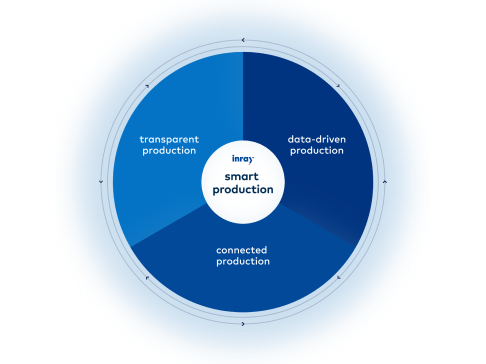
In our understanding of smart production, three areas are interlinked:
- Connected Production: Connect machines, equipment, and systems with one another and make data available.
- Transparent Production: Make production processes and conditions visible and understandable.
- Data-driven production: Use data to strategically manage and automate decisions and processes.
Connected production forms the foundation for this. Without a reliable data connection, the subsequent steps cannot work.
Conclusion: Just get started, and stick with it.
Connected production is not a technology of the future. It is a long-established prerequisite for the digitalization of production.
Real-world examples show that even simple integrations can yield valuable results—from automated data collection and the integration of production equipment to the reduction of unnecessary energy costs.
Companies should therefore not wait for the next major digitalization project, but should first assess which data sources are already available in their production processes and which ones can be tapped with a manageable amount of effort.
After all, if you want to make your production smart, you have to connect it first.
"Connected Production" at the Lunch Talk
How did machine connectivity work 25 years ago? What has changed since then? And what surprising potential lies in everyday production components?
Sören Rose and Mike Elsen will discuss this topic in our Lunch Talk on connected production. They’ll share personal experiences, specific customer examples, and insights into why technical connectivity is the first step toward smart production.
Now this Watch the video here on YouTube Check it out!
To learn more about our industrial data integration solutions, visit inray.de.