Smart Production in Action
How Data Is Transformed Into Effective Processes
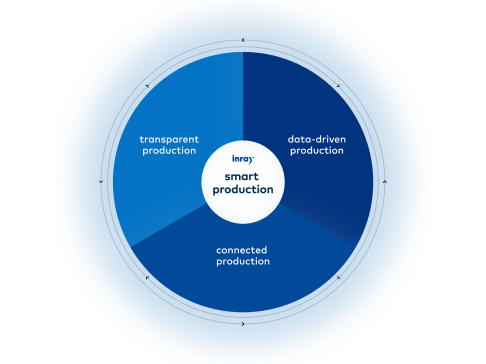
Smart production is not a list of technologies, but a capability: the right information is in the right place at the right time, and this leads to the right actions. This is only possible when connected production, transparent production, and data-driven production work together.
A connected machine doesn't make for smart production, and neither does a dashboard. In our new video, we discuss our central theme and what happens when the three pillars of smart production come together:

Our model in three sentences
We describe in detail how we define smart production and what components it includes on the page What is smart production?. In short:
connected production connects machines and systems via communication channels that are as open and standardized as possible, taking context into account and in both directions.
Transparent Production makes the production status clear for each roll and specifically alerts the connected worker when human intervention is required.
data-driven production enables systems to communicate with one another and translates information into automated system and process actions according to defined rules, thereby eliminating the need for manual intervention.
Our CEO, Mike Elsen, explains in his editorial why none of these skills is sufficient on its own „The Three Pillars of Smart Production—and Why They Only Work Effectively When They Work Together“ derived in detail. Here, we illustrate how these elements interact in a continuous process.
One Process, Three Skills: Starting a Job
A new order is set to begin at a bottling plant. Traditionally, this means manually entering parameters from the recipe, checking with the quality lab to see if the raw material batch has been approved, and hoping there aren't any transposed digits.
Step 1 – Connected Production: The system originally supports only a proprietary protocol. Through an OPC UA server, it is standardized and integrated bidirectionally. The connection is thus available not only to a single application, but to the entire system landscape—from order control to energy analysis.
Step 2 – Data-Driven Production: When the job starts, the master system automatically transfers the approved machine parameters to the production line. At the same time, the process queries the release status of the raw material batch directly in the quality assurance system. If the release is valid and unambiguous, the order begins without anyone having to transfer information between systems. This prevents data entry errors at this interface—such as an incorrect year in the best-by date—from occurring in the first place.
Step 3 – Transparent Production: If approval is missing or the result is inconclusive, the start remains blocked. Instead of a general alarm, the responsible person in quality assurance receives a specific notification including the batch, order, and machine. At the same time, shift supervisors can see in the status overview why the machine is idle and which subsequent orders are affected. If everything is running as it should, the shop floor monitor shows everyone that everything is green—meaning everything is okay.
This does not replace people, but rather lightens their workload: Routine tasks are handled automatically, while responsibility for rules, exceptions, and unclear situations remains with the experts.
What's Missing When a Pillar Is Missing
This process also illustrates why many projects fail. Interconnectivity without transparency generates data but provides no guidance. Transparency without follow-up action remains mere observation. And automation without reliable connectivity and clear rules merely processes incorrect information more quickly.
Transparency alone can make a big difference here: In individual projects, potential savings of up to 30 percent were identified—for example, because compressed air was being consumed while no jobs were running, or because downtime in individual plant components became measurable for the first time. However, the full benefits are only realized through the closed loop of identification, understanding, and action.
Getting Started: One Use Case, Three Questions
Smart production rarely starts from scratch. The best way to begin is with a clearly defined flow of information and actions, viewed through the lens of these three capabilities:
connected: Where does the necessary information come from, and what context is currently missing?
transparent: Who needs what information, when and where, and who needs to take action in the event of exceptions?
data-driven: Which routine actions can the system trigger on its own, and which manual entries does this eliminate?
With each use case implemented, a reusable toolkit of standards, data models, and experience grows. As a result, implementation speed and scalability increase from project to project.
Conclusion
Smart production isn't measured by the number of connected machines or dashboards set up, but by action. This video brings that idea to life in just a few minutes, Mike Elsens Editorial provides a detailed derivation, and on our website What is smart production? Here you'll find an overview of approaches, building blocks, and industries.
Which information flow in your production process has the greatest potential? Request a free potential analysis now.